When the subject of foreigners in the Czech Republic comes up, opinions vary widely. Some acknowledge that migrants help address labour shortages and make a significant contribution to the country’s economy. Others claim that they do nothing but live on state benefits, take jobs away from locals and routinely break the law.
When it comes to immigrants from Russia, the stereotypes become even stronger. Reports about the war and clickbait headlines about yet another offence committed by “Russian-speaking foreigners” add fuel to the fire. It is important, however, not to be misled: around 300 million people worldwide speak Russian — far more than the total number of Russians in the world — and a random “Russian speaker” on a Czech street may not be Russian at all.
As a result, the people featured in such reports often have no connection to Russia. In 2024, for example, Czech media were abuzz with reports claiming that Russians had assaulted a Ukrainian volunteer in Prague. It later emerged that only one person involved in the incident was of “Russian-Ukrainian origin”, while the others came from “another country of the former Soviet Union”.
Such reports sometimes turn out to be completely false. In 2023, the German newspaper Die Welt published an article claiming that a “Russian-speaking man attacked and physically harmed children because they were speaking Ukrainian”. The story was republished by many Czech media outlets, including major, well-known newsrooms. The iDNES.cz news portal, for example, published the report. See how the “Russian-speaking man” in the original article became simply a “Russian” in the headline, without any confirmed basis. This kind of shift in meaning occurs regularly in the Czech media.
A police investigation later revealed that the situation had been entirely different. There had been no incitement to hatred, nor any attempt to cause harm, and the boy admitted that he had lied to the police. Die Welt removed the original article from its website and published a follow-up describing the new findings in the case: Ukrainischen Jungen von Brücke geworfen? Wende im Fall Einbeck – WELT.
Yet none of the Czech outlets that had republished the original story removed their articles or published a follow-up with the results of the investigation—even after their newsrooms received numerous letters asking them to report on the case objectively.
False stories and clickbait headlines are not the only problems affecting media coverage of Russians in Czech Republic. Sometimes the media instead choose to omit “inconvenient” facts and events that do not fit the picture some wish to present. Dmitry, a member of the JsmeLide community, recalls the events of 24 February 2022:
…I made a banner and went to the embassy. More and more people kept arriving. By evening, several thousand people were packed into the small square. A Seznam Zprávy reporter approached us and interviewed me. When she learned that we were Russians, she was surprised and expressed her sympathy. In the end, the interview was never published. Instead, they published a photograph of me standing with another Russian woman, captioned: “Ukrainians and Czechs took part in the demonstration.”
Russians encountered the same selective media approach during the adoption of the law freezing their access to Czech citizenship. Only one small Czech outlet found the courage to report the facts accurately. Viewed objectively, the result is blatant discrimination in the heart of Europe, in the only country in the world to have adopted such a measure.
Russians in the Czech Republic: Who Are They, and What Do the Facts Say?
Let us look honestly at the facts. What do statistics, official data and objective evidence show? We can begin with data from the Czech Statistical Office, which show that among the main groups of foreign nationals in the Czech Republic, Russians have the highest proportion of workers with a university education: 41%.
Among Russians, 41.1% had a university degree and a further 20.3% had higher vocational or bachelor’s-level education. Among Slovaks, the corresponding figures were 31.2% and 6.2%, while among Czech citizens they were only 18.6% for university education and 6.9% for higher vocational or bachelor’s-level education. Among citizens of Ukraine, Poland, Bulgaria and Romania, 10–12% had a university education; in the Vietnamese community, the figure was just 2.8%.
According to official statistics, most Russian citizens came to the Czech Republic to study or work. Approximately 25.3% work in professional occupations, while 5% hold managerial positions. This is the highest proportion among all groups of foreign nationals in the country. Slovaks rank second for their share of qualified workers, at 17%.
Under the ISCO-08 classification, “professionals” are highly qualified workers such as engineers, programmers, doctors, lawyers, university lecturers, architects and scientists.
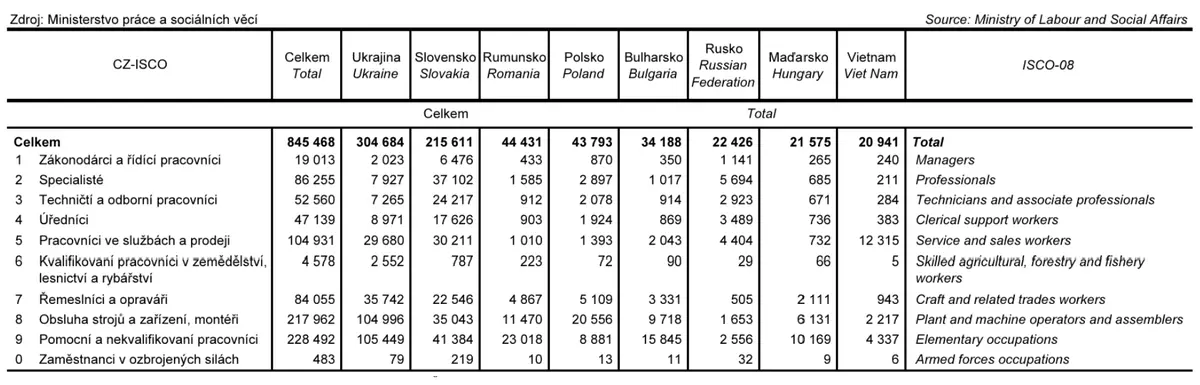
Their high qualifications, educational attainment and demand in the labour market are also reflected in the fact that Russian citizens form the largest group of holders of so-called “EU Blue Cards”. The EU Blue Card is a residence permit for the employment of educated, highly qualified professionals such as scientists, engineers, programmers and lecturers. The requirements are strict: applicants must have a university education or several years of documented professional experience, as well as a job offer from a Czech employer with a salary above the national average. The employer must also prove that no Czech candidate with the required qualifications could be found for the position.
Among all foreign nationals whom Czech companies and organisations have invited to move to the Czech Republic under the Blue Card program, Russians rank first. According to the latest available data for January 2024, 568 of the 1,834 Blue Card holders in the Czech Republic were Russian citizens—almost one in three. Citizens of India came next, followed at a considerable distance by citizens of Ukraine.
These figures are all the more remarkable because, since the beginning of the pandemic in 2020, new work visas and residence permits have been issued to Russian citizens only in minimal numbers, and since 2022 they have not been issued at all. Over the past six years, many Blue Card holders have also obtained permanent residence, so their number was substantially higher in the past. For example, according to available data for January 2024, 568 of the 1,834 Blue Card holders in the Czech Republic were Russian citizens—almost one in three. In 2021, Russian citizens accounted for almost half of all foreign nationals in the Czech Republic who held this type of permit.
Crime
It is often claimed that foreigners in the Czech Republic do not respect the law and commit offences on a massive scale. The same stereotype is applied to Russians.
Member of the European Parliament Tomáš Zdechovský claimed on his X profile that Russians allegedly made up 10% of inmates in Czech prisons. It soon became clear that this was false information. In the comments, readers linked to the annual statistics of the Czech Prison Service, which show that Russians accounted for about 1.5% of foreign nationals in Czech prisons—just 25 people out of nearly 1,600. X added a note below Zdechovský’s post explaining that his statement was inaccurate. Nevertheless, he neither apologised for spreading false information nor deleted the post. This is precisely how false stereotypes arise and propaganda spreads.
Meanwhile, both the Annual Report on the State of Public Administration in the Czech Republic and a report by the Criminal Police and Investigation Service show that, of all the country’s sizeable groups of foreign nationals, Russian citizens have the lowest crime rate. They rank last—tenth—in the crime statistics. This applies not only to the absolute number of crimes but also to the proportion of offences relative to the size of each foreign-national group living in the country. The statistics have shown this pattern for many years.
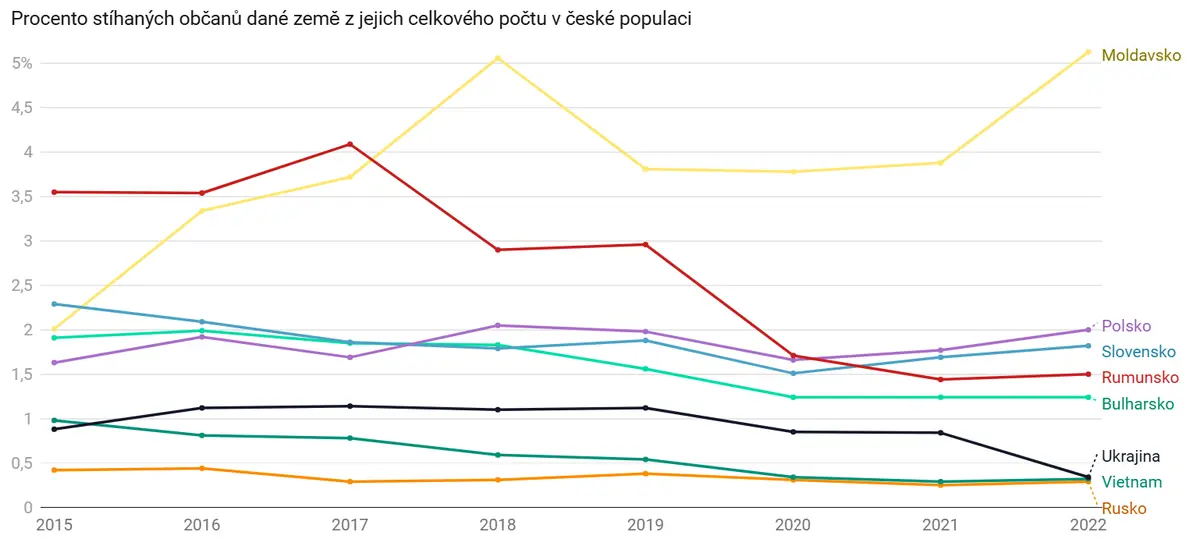
More recent data support the same conclusion. Russian citizens do not appear at all in the 2025 report by the Police of the Czech Republic: the number of recorded offences was so low that they did not even rank among the ten foreign-national groups with the highest number of crimes, despite the inclusion of several much smaller diasporas.
There is also a widespread myth that Russians living here are all spies and “agents”. Yet the fact is that, throughout all these years, no Russian citizen who immigrated to the Czech Republic through the ordinary process—with a visa or residence permit for study, work or family reunification—has been publicly accused of espionage or sabotage. Nor has any of them been charged with “activities on behalf of a foreign power”, the very offence that the STAN party proposed adding to the Criminal Code last year specifically to “protect against external threats”. It turns out that Russians in the Czech Republic do not pose such threats.
It should also be remembered that every application for a visa, temporary or permanent residence, or citizenship is thoroughly vetted by the police and the Czech Security Information Service, and any application may be rejected on the grounds of a “potential security threat”. For many years, until Russian citizens were banned from obtaining Czech citizenship, their application rejection rate was no higher than that of citizens of other countries and consistently declined year by year.
Finally, there is the main myth that is often repeated: the misconception that most Russians support the war. This may be connected to the fact that many Russians in the Czech Republic prefer not to discuss Russian politics or their views on the war in Ukraine with people they do not know well, fearing possible consequences for themselves and their families. Their silence is then wrongly interpreted as support for what is happening.
The political views of Russians living in the Czech Republic should therefore be assessed on the basis of verifiable facts.
Hundreds of Russians have volunteered and helped Ukrainian refugees since the beginning of the conflict, and continue to do so today. Prague also saw a demonstration of several thousand Russians against the war and Russian aggression.
The facts provide the clearest picture. Both the official results of the most recent Russian presidential election at the polling station in Prague and the results of independent exit polls clearly show that only a very small proportion of Russians living in the Czech Republic supported the Russian president’s current policies.
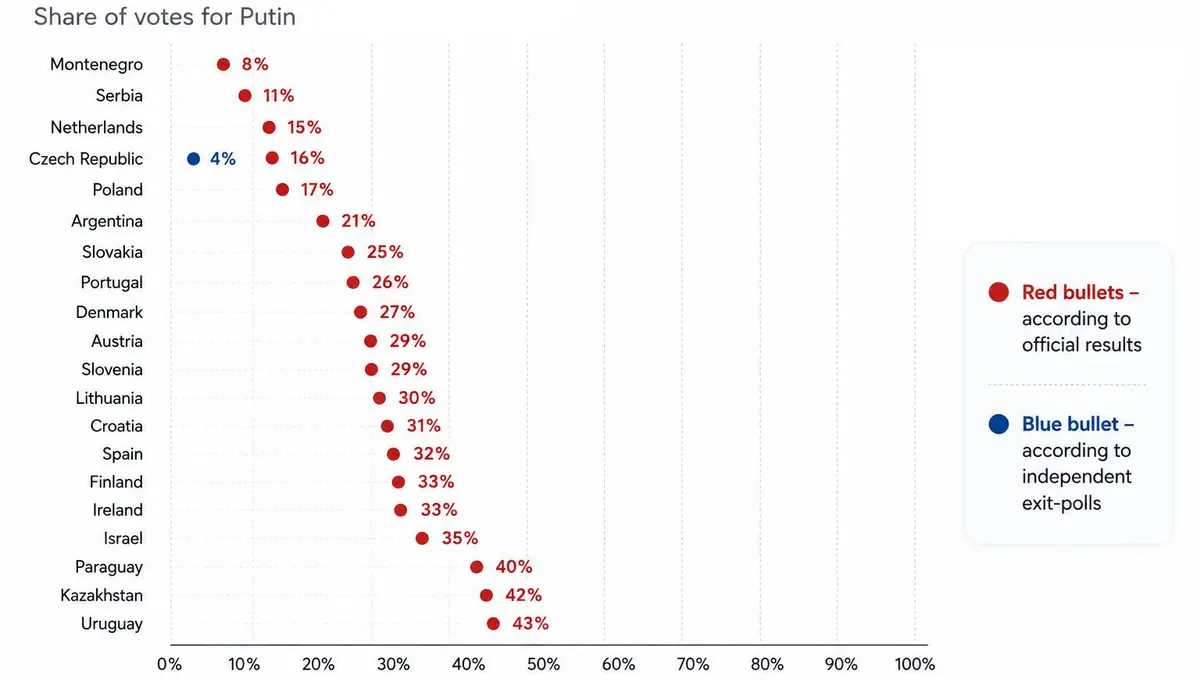
Recently, the head of Russia’s Central Election Commission proposed that Russian citizens living abroad be stripped of their right to vote in Russian elections. Presumably, the authorities are not very pleased with results like these. Unfortunately, however, European media now tend to overlook anything that might show Russians in a positive light. That is probably why you are unlikely to have read about it.
Conclusion
A sober look at the facts makes it clear that reality is entirely different from the picture painted by media outlets that focus on isolated incidents and sometimes openly distort the facts in pursuit of striking headlines. Despite their relatively small number, Russians in the Czech Republic have the highest proportion of educated and highly qualified people among foreign-national groups and make a significant contribution to the Czech economy and society. They are law-abiding people who share pro-European and democratic values.
They live among you, but most people simply do not notice them. They do not cause problems and make an effort to integrate into Czech society. Of course, every social group unfortunately has isolated exceptions, and it is precisely those cases that stay in people’s minds and make the headlines. Decent people—the overwhelming majority, regardless of nationality—rarely attract attention or become the subject of news stories.
Vladislav, a member of the JsmeLide community, sums it up well:
I have lived in the Czech Republic for ten years. Throughout that time, I was simply an ordinary person: I worked, studied Czech intensively so that I could speak without an accent, obeyed the law, tried not to cause anyone any problems, treated people politely and never had any conflicts. Only later did I hear some acquaintances say, “I’ve never met a normal Russian.” Yet they had met one almost every day for all those years — they had simply never thought about it.